
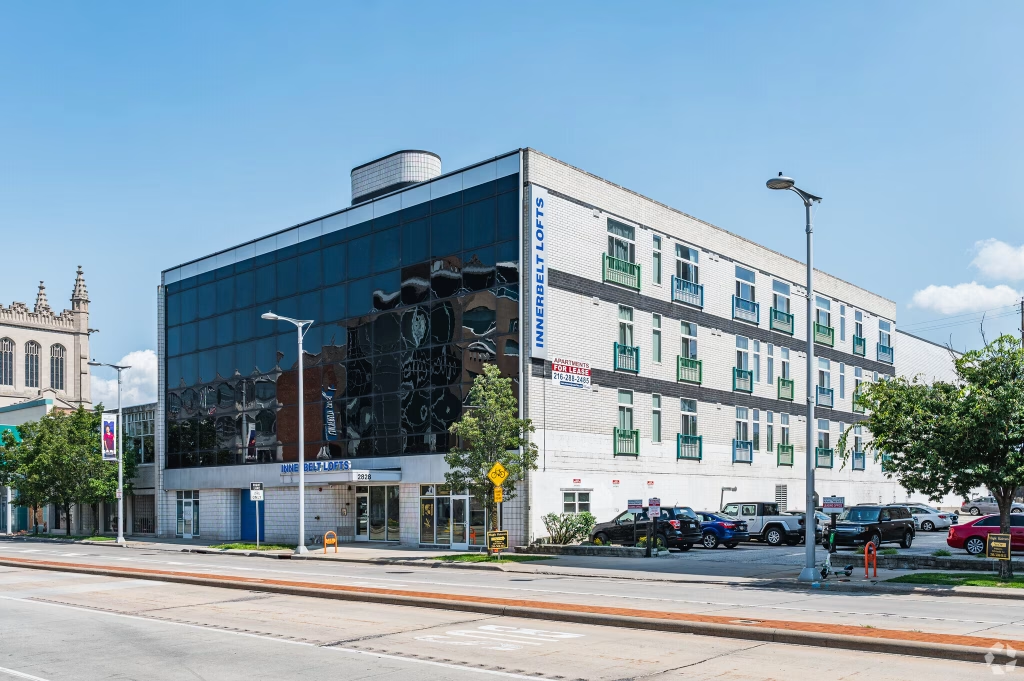
A lot of people will tell you deals don’t work right now. Interest rates are too high. Cap rates are too compressed. You can’t make the numbers pencil.
I want to show you a deal we just closed that cash flows positive from day one, has a 22.86% projected annualized return for investors, and was structured in a way that keeps debt costs manageable even at today’s rates. It’s a 58-unit Class B+ apartment building in downtown Cleveland, Ohio, and I’m going to walk you through every number.
The Property
This building was gutted down to the studs in 2018 and completely rebuilt. Brand new mechanicals, electrical, plumbing, HVAC, flooring, fixtures, bathrooms, kitchens — everything. The previous owner did the full renovation, stabilized it, leased it up, and refinanced it into long-term debt. So when we came in, we were acquiring a fully renovated building with an assumable loan already in place.
The deal came through my network. Someone I knew was an investor in the project and knew the general partners were looking to sell. There were some complications with the operating partnership — nothing wrong with the property itself — and that created an opportunity for us to step in.
The Acquisition Financials
At purchase, here’s what the numbers looked like.
The building had a gross potential rental revenue of about $981,000 per year — that’s every unit occupied at current rents. With a 5% vacancy rate, the gross collected income came in at roughly $940,000 per year.
Expenses broke down into five buckets:
- Property taxes: $31,000 per year. The building received a 15-year tax abatement from the city of Cleveland because of the 2018 renovation. There are still about eight years left on that abatement, which is a significant competitive advantage.
- Insurance: $23,000 per year. Low because the property is essentially brand new.
- Utilities (landlord-paid): $89,000 per year.
- General maintenance: $60,000 per year.
- Management, marketing, legal: Just over $100,000 per year.
Total expenses: roughly $303,000 per year.
Net operating income at acquisition: $632,000 per year.
Our all-in price — purchase price, closing costs, and reserves for capital improvements — was $9.953 million.
Dividing the NOI by the all-in price gives us a cap rate at cost basis of 6.35%.
The Financing Structure
This is where the deal gets interesting, because the financing is what makes it work in today’s rate environment.
The property had an assumable loan of just over $6 million at a 4.5% interest rate on a 30-year amortization, with a balloon payment in about six or seven years. We stepped in and assumed that loan with the existing terms. That alone is a significant advantage — getting $6 million of debt at 4.5% when the market rate is north of 7% changes the deal economics dramatically.
We also negotiated seller financing of $880,000 at 3% interest-only. This isn’t a second mortgage. It’s an unsecured promissory note — the seller was confident enough in our ability to perform that they accepted a promise to pay them back over the next several years without taking a security interest in the property. They got their asking price. We got low-cost capital.
The remaining $3 million came from equity investors (LPs) at a 10% preferred return, structured as 5% paid current and 5% accruing until refinance.
Here’s the blended cost of capital across all three layers:
- Assumed loan ($6M at 4.5%): ~$270,000/year
- Seller financing ($880K at 3%): ~$26,400/year
- LP capital ($3M at 5% current): $150,000/year
- Total annual cost of capital: ~$585,000
With an NOI of $632,000 and a total cost of capital of $585,000, we have a spread of $45,000 to $50,000 in positive cash flow from day one. Our blended cost of capital works out to about 5.89% — below our 6.35% cap rate at cost basis, which means the deal cash flows.
That’s the basic test for any deal: is your NOI greater than your debt service? Is your cap rate greater than your blended cost of capital? If yes, you have a cash flowing deal. If no, you don’t.
The Business Plan
We acquired the property below market rents, which gives us a clear value-add path without having to swing a hammer.
At full market rents with a 5% vacancy and a 2% annual expense escalation built in, we project a stabilized NOI of $814,000 per year within 36 to 60 months. We set 60 months as the target and expect to hit it around 36 — I’d rather exceed expectations than miss them.
At a 6% cap rate, a stabilized NOI of $814,000 puts the property value at $13.58 million. We’re all-in at $9.953 million. That’s roughly $3.6 million in forced appreciation over the hold period, created by pushing rents to market rate and improving management efficiency — not by spending millions on renovations.
At that point, our plan is to refinance into agency debt at a 70-75% LTV. At a $13.58 million value, that’s roughly $9-10 million in loan proceeds — enough to pay off the existing assumed loan when it matures, return all investor capital, and lock in long-term fixed rate debt while maintaining ownership.
How We Split It With Investors
My company took 50% of the deal. Our LPs took 50%.
For the work we did — finding and negotiating the deal, sponsoring the loan, raising the LP capital, executing the value-add plan, and handling ongoing asset management — we took an acquisition fee of $298,000 at closing. That keeps the lights on and keeps the team compensated for the work it took to get here.
Going forward, we receive 50% of the positive cash flow. At acquisition that’s about $23,000 per year. As rents grow to market rate, we project that growing to around $100,000 per year. We also earn management fees of about $33,000 per year. So from day one, we’re generating around $56,000 per year plus the acquisition fee, with significant upside as the property stabilizes.
For the investors, here’s what the deal looks like over a 60-month hold:
- $3 million invested
- 10% preferred return (5% current, 5% accruing): $150,000 per year current + $750,000 accrued at refi
- All $3 million returned at refinance
- 50% equity stake maintained after return of capital, cash flowing $100,000+ per year at stabilization
- Year one depreciation of $1.5 million passed through to investors, offsetting taxable income
Total projected return over 60 months: $3.429 million. That’s a 22.86% annualized return — or close to 30% when you adjust for the tax savings from depreciation.
What Makes This Deal Work
A few things made this deal possible that aren’t available on every acquisition:
The assumable loan. Getting $6 million at 4.5% in today’s market is the single biggest reason this deal cash flows. Without that, we’d be financing at 7%+ and the numbers wouldn’t work at this price. Assumable debt is one of the most valuable things you can find right now. It’s worth specifically looking for it.
The tax abatement. Eight years of remaining tax abatement on a property where taxes would otherwise be a significant expense line is a meaningful NOI boost. Before buying anything, check with the local municipality — many cities have abatement or exemption programs for properties that have recently been renovated.
The seller financing. We got $880,000 at 3% interest-only because we had the relationship, the credibility, and the right ask. The seller got their price. We got low-cost capital. Seller financing doesn’t happen on every deal, but it’s worth asking about on every deal.
Buying below market rents. We didn’t need to renovate anything to create value — the upside was already there in the rent gap. Finding a well-maintained property with rents below market is often a cleaner play than buying a distressed asset and renovating it.
The Bigger Point
This single deal generated about $200,000 personally for me in the first year, and it increased my net worth by over a million dollars. That’s one deal.
Now imagine what this looks like at a fifth the scale. A five-unit building with one tenth of these numbers is still $20,000 upfront and a few hundred dollars a month of cash flow — plus six figures of appreciation over the hold period. That changes someone’s financial life.
You don’t have to start with a $10 million building. But you do have to start. And you do have to understand that the deals are there if you know how to structure them.
Managing the financial complexity of a deal like this — tracking NOI, expenses, rent growth, and investor distributions across every property in your portfolio — is exactly what Smart Management is built for. One platform, real-time data, no more piecing it together from five different systems. See how it works.
This post reflects my personal experience acquiring a 58-unit apartment building in Cleveland, Ohio. It is not legal or financial advice. Deal structures, returns, and financing terms vary significantly by market, lender, and circumstance. Always consult qualified legal and financial professionals before structuring any real estate transaction.